GIséle_Vienne

Alpine tales and metal: Kindertotenlieder by Gisèle Vienne and KTL in the Holland Festival.

Text: Neil van der Linden
“Thank you for coming to this memorial concert for my friend, and I want to thank one of this favourite bands for agreeing to play here today. He was my friend since we were 2 years old, and I knew he would have…” (voice cut). These are the words of one of the characters on stage, Jonathan, commemorating the death of his friend. Whom he supposedly killed, we are about to learn.

On stage is a group of people in a snowy landscape, some of them are children. In one corner of the scene there is a coffin, with the lid open. Slow movements, slowly evolving electronic sounds. But after a while one of the people runs to two of the children in front and makes movements as if killing them. Kindertotenlieder is the title. Killing children and snow, I had to think of Brueghel’s The Massacre of the Innocents; I will come back to that later.
The children figures turn out to be stuffed puppets; I will come back to that later too.

A guitarist starts to play growling loud slowly progressing chords, style ‘black metal’. The audience has been given earplugs.
The actors keep on moving slowly to a virtual point on the left of stage where rays of light are shining from.
The killer gets killed by another character.
After a while the former rises again and grabs another character, takes off his clothes and stammers texts about raping him, and then kills him. Spoken text suggests that that was the person who was probably murdered by Jonathan.

The group keeps moving to the light, so slow some seem like puppets. After a while we notice that some did not move at all: they are puppets.
Another actor grabs some of the other figures, the puppets, and stacks them up together.

More snow is falling. Heaps and heaps of snow. Everybody still alive now has their winter coats fully buttoned up, except for the naked rape and murder victim, still lying on stage. It turns out that the young boy who was killed by his best friend has returned as a ghost during his funeral, and the story started from there.

Kindertotenlieder is a performance from 2007 by Gisèle Vienne, who along with Japanese composer and actor Ryuichi Sakamoto is associate artist of this year’s Holland Festival.

The two musicians on stage, Stephen O’Malley on guitar and Peter Rehberg on electronic equipment, work together under the name KTL (KinderTotenLieder!, I assume) since they participated for the first performances in 2007. In the storyline the murdered boy’s favourite music was KTL. Their style,, ‘Black metal’, is often associated with satanism and ‘doom’cults.

Another cult that plays a role in the performance is the German and Austrian Alpine rite of the Perchten. Gisèle Vienne is partly Austrian. At some point in the wintery landscape on stage two tall figures appear, dressed as ‘Perchten’. Perchta (English: Bertha) was a pagan goddess in the German and Austrian Alps. She lived on since the arrival of Christianity, entering village homes during the twelve days between Christmas and Epiphany, especially on the Twelfth Night. She knows whether children and young servants have behaved well and worked hard. If not, she would slit their bellies open, and stuff them with straw and pebbles. There you have it, child murder and stuffed puppets, two of the elements we see on stage.
For centuries after paganism disappeared boys would roam villages wearing animal masks, the midwinter Perchten feasts that still exist in the region, intended to chase out winter.

Maybe the title of the performance is derived from (Austrian composer) Gustav Mahler’s Kindertotenlieder, in which the composer reflects on the death of children; to which Mahler and the poet of the texts Friedrich Rückert were no strangers, Mahler having lost eight of his siblings and later a daughter and Rückert two children.

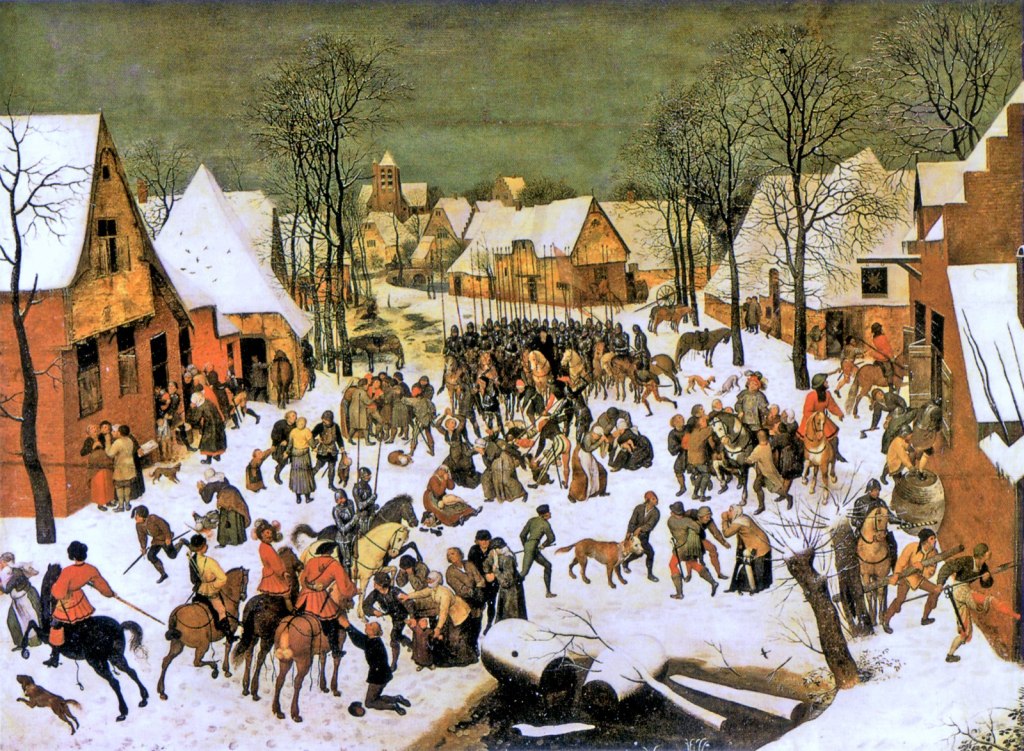
It occurred to me that the idea of child murder in combination with midwinter also can be associated with the ‘celebration’ of Mary and Joseph bringing the newborn Jesus to safety from the troops of King Herod;  as pictured by Brueghel the Elder in his Massacre of the Innocents. When King Herod had learned from The Three Wise Men from the East that stars had taught them that the future king of Jews was born in Bethlehem, he ordered all newborn males of Bethlehem to be killed. Mary and Joseph fled in time after being warned by an angel, and fled to Egypt.  (All other babies were killed; thank You, God.) Brueghel the Elder’s painting, set in a snow-covered landscape, was in fact an allegory on the cruelty on the Spanish occupation troops fighting the Netherlands’ independence movement. Here comes another Austrian link, as what was considered to be the original version of the painting is in the Kunsthistorisches Museum, Vienna. (It is now thought to be a copy by Pieter Brueghel the Younger. But as other authorised versions have been censored for its cruelty, this one shows the original cruel details of the mass-murder as conceived by Brueghel the Elder.

Vienne and Sakomoto are the festival’s associate artists. Partly due to COVID19 and unfortunately because Sakamoto is ill, a full collaboration between the two could not materialise It is possible to envisage why the two artists might have been attracted to each other’s work, with both’ interest in atmospheric music and immersive visual art.

Meanwhile, that the Holland Festival could happen at all including complex productions like Kindertotenlieder and Sakamoto’s opera Time is yet a miracle


Concept and choreography: Gisèle Vienne, dramaturgy and texts by Dennis Cooper, music by KTL: Stephen F. O’Malley and Peter Rehberg.

Zuiveringshal West, Westergas, June 19th 2021, as part of the Holland Festival

Photos by Antoine Masure and Mathilde Darel


Avantgarde and retrospection

Text: Neil van der Linden

Short Circuit

Avantgarde and retrospection, that could be the theme of Short Circuit, a Holland Festival event filled with four performances created by favourites of the festival’s ‘Associate Artists’ Gisèle Vienne and Ryiuchi Sakamoto. The whole program ingeniously made use of the various spaces at ‘De School’, an abandoned school building that for a while was known for its alternative art events and audio-visual parties.

Gisèle Vienne herself made a choreography for performer Katia Petrowick. One of the former classrooms is dressed up as a sort of vintage disco, apparently during in the aftermath of a dance night, with garlands, crumbled drink cans and chips bags lying around on the floor. We hear loud music in the style of mid-eighties Detroit techno or the kind of music Alex Patterson of the Orb would play during after-parties; I remember great nights at Paradiso and Fuse/La Démence in Brussels. Petrowick enters and moves across the floor in slow motion, while the music still without metre. Knowing that the whole event is supposed to last three and a half hours, at first you could be inclined to ask yourself am I ready to attend this kind of things for such a long time, but soon the whole ambiance of performance takes over, and the music catches tempo.

As absurd as it may sound, a highlight is when the character on stage finds a leftover full bag of chips in a Lidl shopping bag and slowly opens it; the thud of the exploding bag being pressed open brings us back in real-time and becomes an almost frightening event.

The whole ambiance reminded me of the magnificent, ghastly movie Climax by Gaspar Noé, about a group of young French dancers having a farewell party before leaving for a US tour, which completely runs out of hands after somebody slips LSD into the drinks, with even mortal consequences, all this on fantastic vintage techno music. I imagined the performance to be the scene of the evening after the events in Climax unfolded.

Meanwhile the performer was about 10 metres away from the front row where I sat, yet the smell of the chips from the bag was penetrating. Also, this for a moment brought me back to the present; if we can inhale the smell chips at 10 metres, what about the aerosols we were afraid of during almost one and a half year? However, no reason to worry, everybody in the audience had to be tested for COVID19 prior to the event. Good to know.

The audience was guided through the performances in various orders. For my group, the evening concluded with a concert by J. Bonnet and Stephen F. O’Malley, performing on guitars and sundry electronic devices. I deliberately use the word sundry as that was the favourite word for pioneering seventies and eighties progressive rock guitarist Robert Fripp describing the instruments he used, and indeed his is the music I had to think of. Harmoniously rich, making use of all the possibilities of distortion, reverb and feedback, and loud. Other alternative rock influences I had to think of are Throbbing Gristle, Sonic Youth, and, talking about loud, the Irish ‘shoegazer music’ band My Bloody Valentine, who were notoriously loud; like with that one My Bloody Valentine concert I attended in Paradiso, I’m still a little deaf after yesterday’s performance, although a bit less deaf than then – time soothes.

The setting was in another former classroom, overlooking a dark seemingly quiet garden outside. But the building is located next to a ramp leading to the Amsterdam ringroad behind it and through the trees every five or six seconds the head- and taillights of cars could be seen, however as their noises were drown out by the sound produced on stage, the lights looked strangely tranquil. By then the three and a half hours had almost passed and you still found yourself glued in a chair absorbed by the whole event that otherwise might have looked like something you had all seen before.

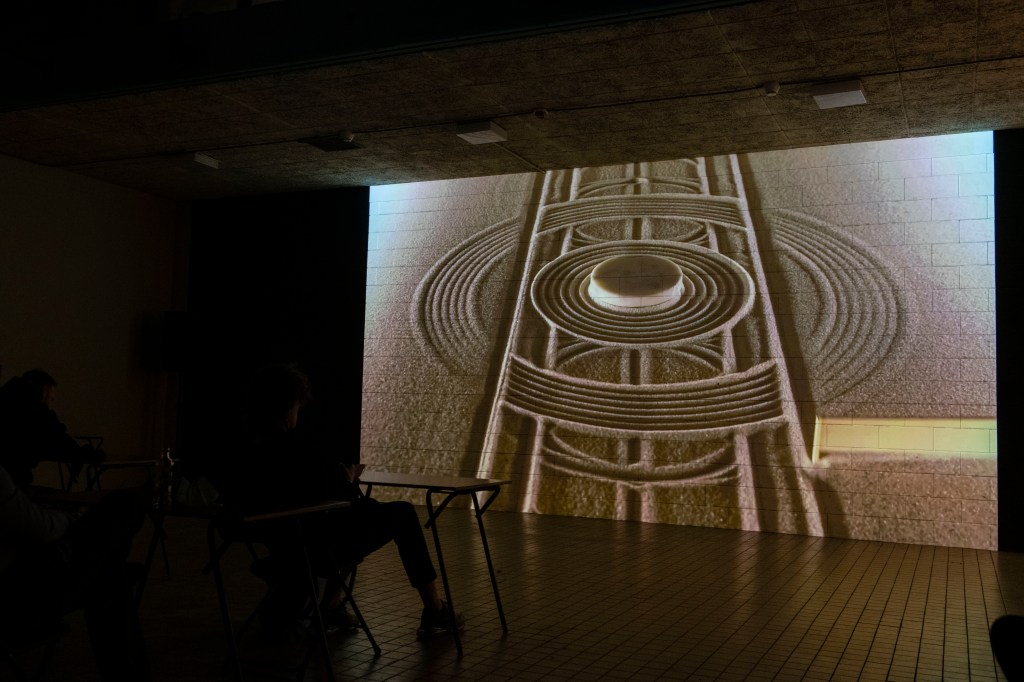
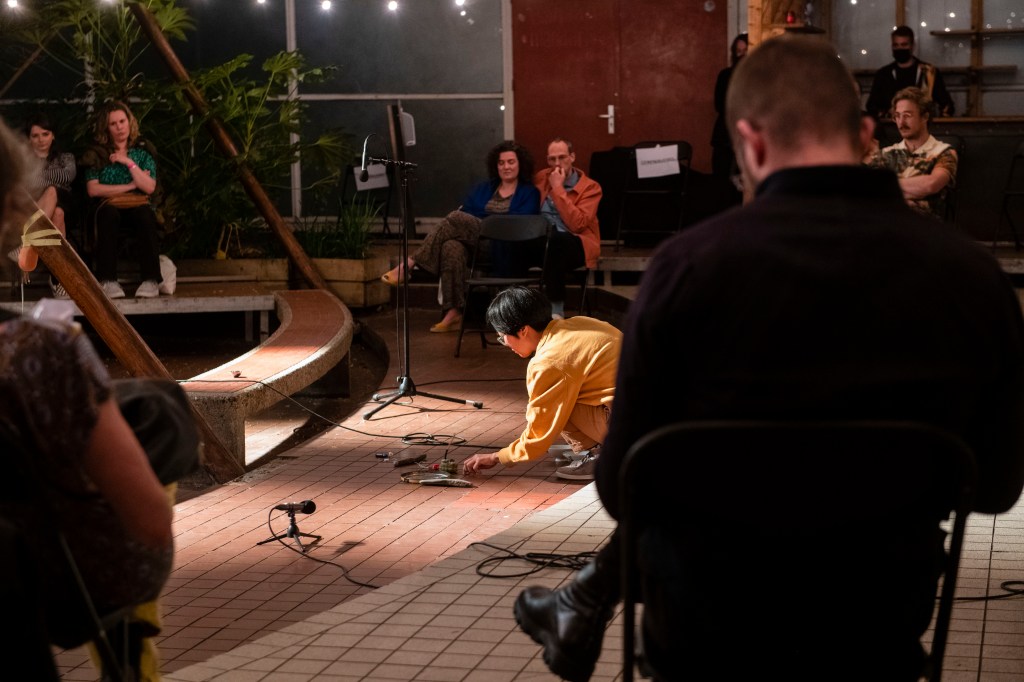
The two, both Japanese, performances in between were of no less ‘nostalgic’ interest. At first Yuko Mohri, who names Satie, Duchamp and Cage as her examples, especially as she shares their use of coincidental elements in music. She puts up small ‘sundry’ household objects dishes, pots, tins, attaching them to toylike mechanical and electric devices that create vibrations causing the objects to resonate. The resulting sounds are captured by directional microphones and transferred to an electromechanics device that play the keys of a piano. The playfulness and the loving care with which everything was carried out were a joy to watch. In the end the audience joined as the sound of the applause was also able to steer the piano keys. In between there was a viewing of a video of the zen gardens created by the artist Yuki Kawae.

For the other Japanese performance, I would also like to name a reference. Tujiko Noriko’s single long song in which she accompanies her etheric voice singing in alternatingly English and Japanese sounded like slow-motion, softened down version of Walking on Thin Ice; if there was only one great example of Yoko Ono’s contribution to pop music to be named, it was that song. She and John Lennon concluded its recording of it in December 1980, the day that on their return from the recording studio John was murdered.

This performance by Noriko, serenely standing next to her laptop in slowly shifting colours from the light installation, probably coincidentally, embodied something dramatic beyond its seemingly soothing sound.

Later in the Holland festival, the performance Kindertotenlieder will reunite Gisèle Vienne, Katia Petrowick and Stephen F. O’Malley,  June 16 and 18, Westergasfabriek.

(And by chance the movie Climax is back in Amsterdam these days at LAB 111.)

Short Circuit, Yuko Mohri, Gisèle Vienne/Katia Petrowick, François J. Bonnet & Stephen F. O’Malley and Tujiko Noriko, and a video by Yuki Kawae, as part of the Holland Festival, De School building, Amsterdam, Saturday June the 12th

https://www.hollandfestival.nl/nl/programma/2021/short-circuit/