Ermanno Wolf-Ferrari

Susanna’s secret

Susanna has a secret. Does she have a lover? That’s exactly what her jealous husband Gil thinks. In the house there is a smell of smoke, so…? Well, no. Susanna doesn’t have a lover and the cigarettes? She smokes them herself. So that’s her secret. It all meant nothing, but Ermanno Wolf-Ferrari managed to turn the sneering story into one of the funniest comic operas ever.

His music is divinely beautiful. More, in fact. In his notes, he managed to capture all moods. Angry, happy, troubled, angry, happy… You can hear it. Genius. That the opera is still rarely performed has everything to do with our contempt for anything that smells of verismo. For the peace of mind of verismo-haters: no, Il Segreto di Susanna is not a verismo opera, it is more like a commedia dell’arte. Or, flatly put, a delightful interlude.

The live recording from 2006 is excellent. Ángel Ódena is a more than convincing husband and Judith Howarth a sweet-voiced Susanna. For me, the latter is (the only) immediate downside of the recording: Surely Susanna could be a bit more outspoken! Those who know the recording with Renata Scotto know what I mean.

As a bonus, we get Wolf-Ferrari’s youth work, a Serenade for strings. And beautiful it is! The excellent playing Oviedo Filarmonia is under the very enthusiastic direction of Friedrich Haider.

Recording with Renata Scotto:

How Talitha was raised from the dead

In the late nineteenth century, Ermanno Wolf-Ferrari fell under the spell of church music composer Don Lorenzo Perosi, with whom he also became friends. It was also under Perosi’s influence that Wolf-Ferrari composed his cantata Talitha Kumi and the choral work La passione.

The latter, which was based on ancient Italian folk poetry, Wolf-Ferrari also dedicated to his friend. The beautiful youthful work ‘Otto cori’ also betrays the composer’s great love for Renaissance music.

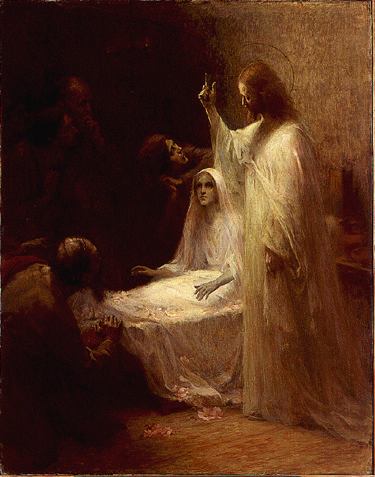
Talitha Kumi!” means “Get up!” in Aramaic. It is a quote from the Gospel of Mark which tells the story of Talitha, the daughter of Jairus. She is dying and in his despair – and hope for a miracle – Jair goes to seek help from Jesus. When Jesus reaches the house of Jairus, the girl is already dead, yet he manages to raise her from the dead.

Resurrection of the daughter of Jairus, by Victor-Oscar Guétin, 1902.

It is the evangelist who carries the story of the work: tenor Rainer Trost sings his text very impressively and manages to keep the listener glued to his every word. Jairus and Jesus have relatively little to do, but both roles are excellently performed here by baritone Joan Martín-Royo. The choir and orchestra have no more than a contemplative role. Call it a ‘colour-wash’ background.

Ermanno Wolf-Ferrari: hoe Talitha uit de dood werd gewekt

Wolf Ferrari Talitha

Eind negentiende eeuw raakte Ermanno Wolf-Ferrari in de ban van de kerkmuziekcomponist Don Lorenzo Perosi, met wie hij ook bevriend werd. Het was ook onder Perosi’s invloed dat Wolf-Ferrari zijn cantate Talitha Kumi en het koorwerk La passione componeerde. Dat laatste, dat gebaseerd was op de oude Italiaanse volkspoëzie heeft Wolf-Ferrari ook aan zijn vriend opgedragen. Ook het prachtige jeugdwerk ‘Otto cori’ verraadt de grote liefde van componist voor de muziek uit de Renaissance.

‘Talitha Kumi!’ betekent ‘Talitha: sta op!’ in het Aramees. Het is een citaat uit het Evangelie van Marcus waarin het verhaal van Talitha, de dochter van Jaïrus wordt verteld. Talitha is stervende en in zijn wanhoop – en de hoop op een wonder – gaat Jaïrus de hulp zoeken van Jezus. Wanneer Jezus het huis van Jaïrus bereikt is het meisje al dood, maar toch het lukt het hem om haar uit de dood op te wekken.

Het is de evangelist die het verhaal van het werk draagt: de tenor Rainer Trost zingt zijn tekst zeer indrukwekkend en weet de luisteraar aan zijn lippen te kluisteren.

Jaïrus en Jezus hebben relatief weinig te doen, maar beide rollen worden hier door de bariton Joan Martín-Royo uitstekend vertolkt.

Het koor en het orkest hebben een niet meer dan een contemplatieve rol. Noem het een met penseel getekende achtergrond.


ERMANNO WOLF-FERRARI
Talitha Kumi! (Die Tochter des Jairus) op.3
La Passione, Op.21 (Tuscan folk poem)
Otto cori, Op.2 for a capella choir
Rainer Trost (tenor), Joan Martín-Royo (bariton), Coro El León de Oro olv Marco Antonio Garcia de Paz
Oviedo Filharmonia olv Friedrich Haider
Naxos 8573716