
This stunningly beautiful composition consists of short pieces (children’s scenes) flowing into each other. The first scene Canto d’amore is followed by the sound of clappers (The Only Instruments). There are quotes from Klezmer music and Yiddish songs. We hear train sounds, a grim March of Suitcase, shoes and coats and several songs.
Song I is about fear. Song II about children’s furniture that no longer inspires trust, and Song III about being locked in a dark closet. A closet so small there is only room for one leg. All three songs are filled with immense fear and darkness and death (“bei den Toten ist mein Haus und in der Finsternis is mein Bett gemacht”)
The fourth and final song (The End. What really happened) is based on the eyewitness report by Marek Rudnicki, which was published in the Polish Tygodnik Powszechny in 1988
Burkhardt Söll
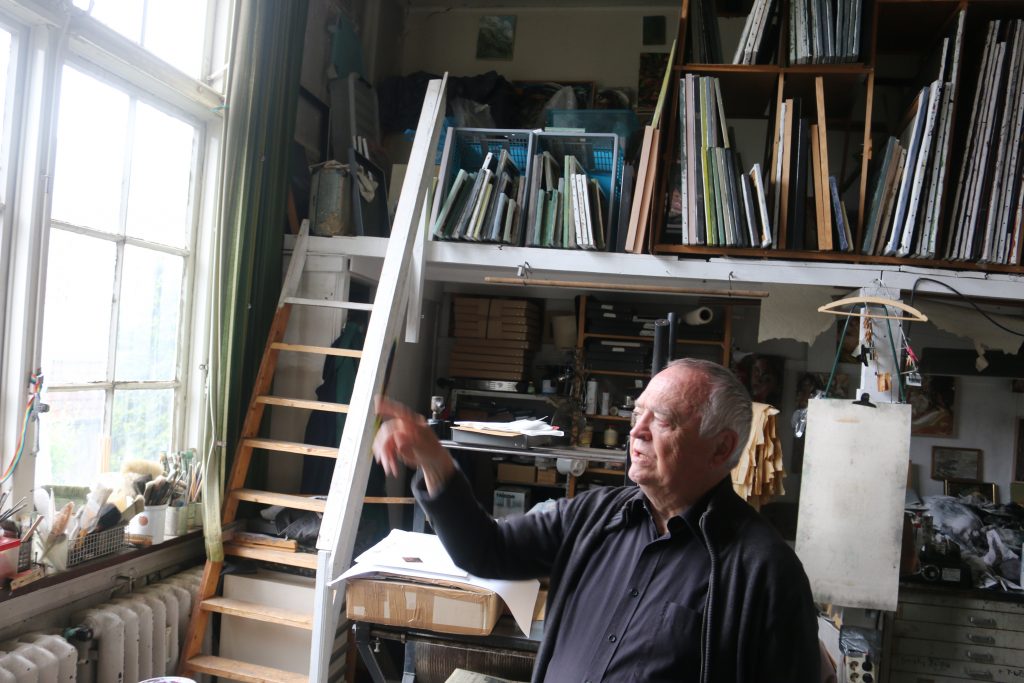
© Wilm Weppelmann
Burkhardt Söll was born in Marienberg in 1944. His mother was Jewish. During his first violin lessons, which he took from his aunts, he was allowed to play klezmer music by the one, but not by the other!
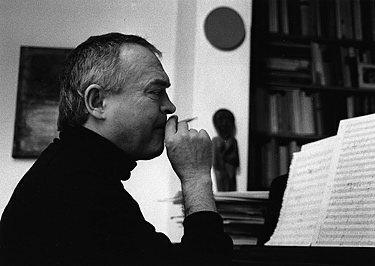
Söll studied viola with the famous Rudolf Kolisch. Already in school he composed for the school orchestra. He continued his training at the Hochschule der Künste in Berlin where he studied composition with Boris Blacher and Paul Dessau and painting with Horst Antes. Afterwards, he was the assistant of Bruno Maderna and later of Otmar Suitner at the Berlin Staatsoper Unter den Linden.
Kinderdinge is a concert version of Söll’s earlier piece of musical theatre Ach und Requiem from 1994/1995, which in turn was preceded by Little Requiem composed in 1991.
What interested me was why Söll wrote a piece of musical theatre on Korczak? Where did his interest in the fate of the old doctor and his children come from? Is it at all possible to tell his story in music? These questions were enough reason to visit the composer in Leiden where he has lived since 1977.
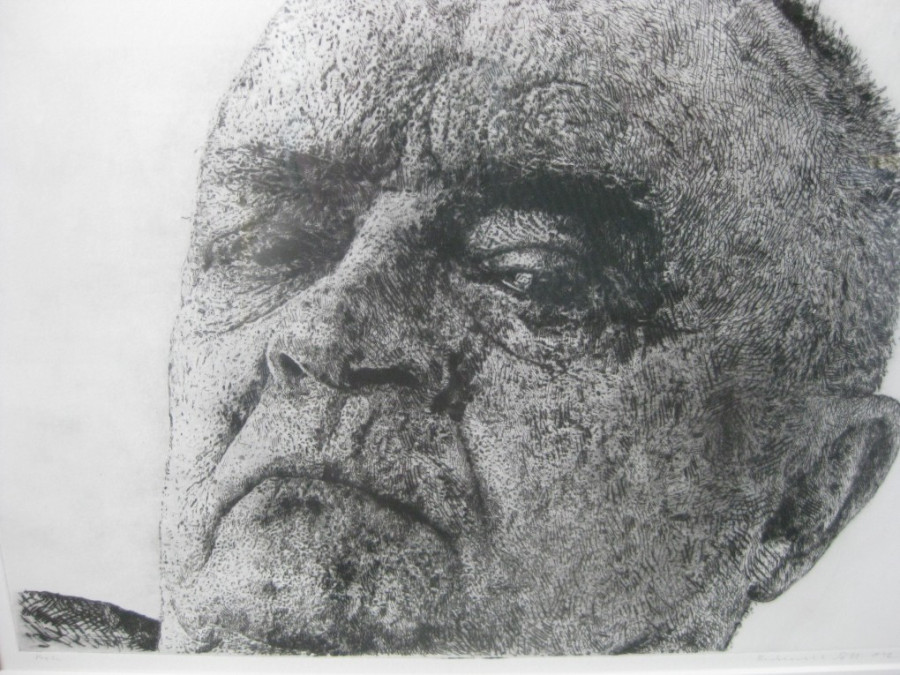
Burhardt Söll self portrait
In the seventies Söll took part in a research project on children’s aesthetics. He developed a teaching strategy combining music composition with painting. In 1985 he was appointed as a teacher at the Utrecht School of the Arts. His paintings were exhibited in Berlin, Frankfurt, Paris, The Hague, and other places.

Söll has known Janusz Korczak and his books since his early childhood. Krol Macius I (King Matt the First) is still his favourite book. The life of the old doctor has always fascinated him: someone who put his life at the service of (orphan) children and remained faithful to his own ideals until death.
Reinhart Büttner’s designs for black and misshapen children furniture inspired Söll to write his piece of musical theatre. Ach und Requiem was performed only once in 1995, but luckily a recording exists. It is a shame the textbook, with a Jewish child playing the violin on its cover, is almost illegible. The letters are too small, and the colour combination (dark brown and light blue) makes it even harder to read.
Fragments can be listened to here:
https://www.muziekweb.nl/Link/AEX1367/Kinderdinge-music-for-Korczak-and-his-children
Burkhardt Söll
Kinderdinge
Music for Korczak and his children
Djoke Winkler Prins (soprano),
Mary Oliver (viola), Alison McRae (cello), Huub van de Velde (double-bass), Jörgen van Rijen (trombone),Wilbert Grootenboer (percussion), Dil Engelhard (flute), Jan Jansen (clarinet), Henri Bok (saxophone)
Conductor: Peter Stamm
BVHAAST CD 9703
 Basia con fuoco