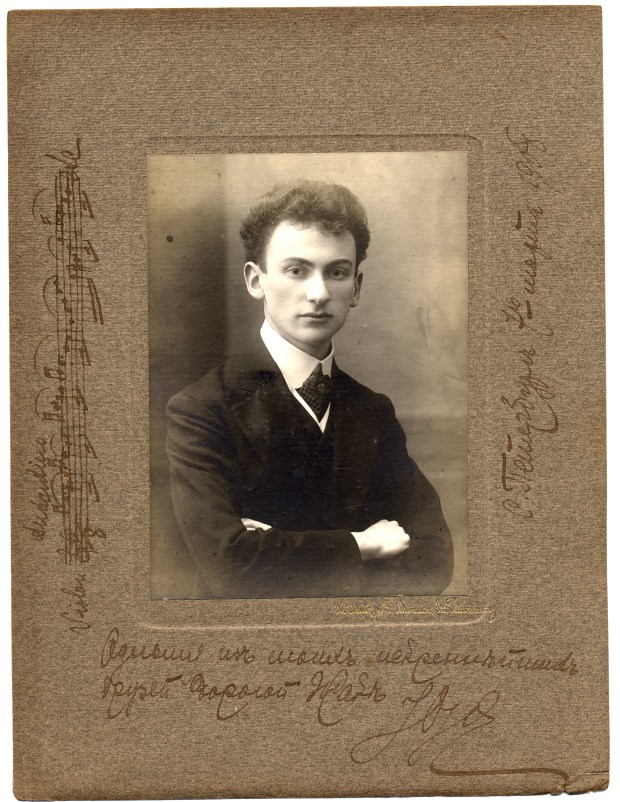
Joseph Achron in Saint Petersburg © Courtesy of the Department of Music, Jewish National & University Library, Jerusalem, Achron Collection.
Arnold Schoenberg firmly believed that Joseph Achron was the most underrated composer of his generation. Schoenberg praised his originality and claimed Achron’s music was destined for eternity. Yet, despite his enthusiastic praise, Joseph Achron never became a household name.

Violin buffs no doubt know his Hebrew Melody, a much loved encore of many violinists, starting with Heifetz.

Hebrew Melody, here played by Josef Hassid:
Hebrew Melody is inspired by a theme Achron heard as a young boy in a synagogue in Warsaw. It is one of his earliest compositions, dating from 1911, and his first “Jewish” work. In the year he composed it Achron joined the Society for Jewish Folk Music.
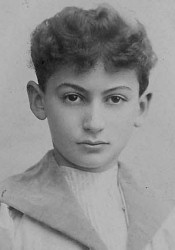
Joseph Achron as a child in Warsaw
But let’s start at the beginning. Joseph Achron was born in 1886 in Russia and died 57 years later in Los Angeles. His mother was an estimable singer, and his father was a cantor who also played the violin. Joseph received his first violin lessons from him, but soon he was replaced by professional teachers. At age eight he gave his first performance, and by the time he was eighteen, he had finished his first compositions.

© Milchen Archive
His career as a composer properly started in the twenties of the last century. In Saint Petersburg, Achron joined the composers of the “New Jewish School.” Several years later he moved to Berlin, where he got acquainted with the works of the French impressionists, and the Second Viennese School.
In 1924 he made a trip of several months to Palestine. He not only performed there, but also collected a huge variety of folk music he discovered there. The notes he took during this trip were later used for several of his compositions. In his Violin Concerto No. 1, Op. 60 (1925) several Yemenite themes can be heard.

Joseph Achron (right) with members of the cast of The Golem. H. Leivick (center), New York.
Credit: Courtesy of the Department of Music, Jewish National & University Library, Jerusalem, Achron Collection.
In 1925 he moved to New York where he was invited to compose music for the Yiddish theatre. Achron wrote the music for several of their productions, including Stempenyu, a play by Sholem Aleichem about a Jewish violinist.
The Stempenyu Suite, performed by Karen Bentley Pollick and Jascha Nemtsov:
In the thirties Joseph Achron moved to Hollywood, where he died in 1943.

Joseph Achron with Otto Klemperer (right). Klemperer conducted the premieres of Achron’s second and third violin concertos with the Los Angeles Philharmonic. © Courtesy of the Department of Music, Jewish National & University Library, Jerusalem, Achron Collection

 Basia con fuoco
Very very interesting, real revelation
LikeGeliked door 1 persoon